

“Court marriage” is the popular name for a marriage solemnized under the Special Marriage Act, 1954 before a Marriage Officer. It does not take place in a court: in Delhi the Marriage Officer is an officer of the Delhi Government’s Revenue Department, which states that “SDMs/ADMs/Deputy Commissioners have been authorised as Marriage Officers”. Any two persons may marry this way, whatever their religion, if the conditions in Section 4 of the Act are met: the man has completed 21 years and the woman 18, neither has a spouse living, both can give valid consent, and they are not within the prohibited degrees of relationship. The couple give written notice to the Marriage Officer of the district where at least one of them has lived for at least thirty days (Section 5), the notice is published in the office, anyone may object within thirty days (Section 7), and after those thirty days the marriage is solemnized before the Marriage Officer and three witnesses and entered in the Marriage Certificate Book (Sections 11 to 13). A same-day court marriage is therefore not possible.
This guide explains the law step by step, the Delhi procedure as the Delhi Government’s own pages describe it, and how a court marriage differs from registering a marriage already performed by religious rites, including an Arya Samaj marriage, with a summary in Hindi.
Court marriage in Delhi at a glance
- What it is: a marriage solemnized under the Special Marriage Act, 1954 before a Marriage Officer, with three witnesses (Sections 4 and 11 to 13). The Act never uses the words “court marriage”.
- Who can marry: “any two persons”, of any religion, if the man is 21 and the woman 18, neither has a spouse living, both can give valid consent and they are not within the prohibited degrees (Section 4). No conversion is needed.
- Where in Delhi: before the Marriage Officer (SDM, ADM or Deputy Commissioner) of the area where one of the couple lives, not in a court; applications can be made through the Delhi Government’s e-District portal.
- Notice: written notice to the Marriage Officer of a district where at least one party has resided for at least thirty days immediately before it (Section 5); it is entered in the Marriage Notice Book and affixed in the office (Section 6).
- Thirty days: objections, only on a Section 4 ground, within thirty days of publication; solemnization only after that (Section 7). An objection is decided within thirty days, and a refusal can be appealed to the district court within thirty days (Section 8).
- Certificate: the couple and three witnesses sign a declaration (Section 11), each party says “I, (A), take the (B), to be my lawful wife (or husband)” (Section 12), and the certificate in the Marriage Certificate Book is “conclusive evidence” (Section 13).
- Three-month limit: no solemnization within three calendar months of the notice means a new notice (Section 14).
- Fees: Rs 100 for the notice and Rs 500 to solemnize or register the marriage under the Delhi Special Marriage Rules, 1956, as amended on 20 December 2016; Rs 100 per certified copy. Some undated Delhi Government pages still show older, lower figures; confirm the fee on e-District when applying.
- Already married by religious rites? Register the marriage instead, under the Hindu Marriage Act, the Delhi (Compulsory Registration of Marriage) Order, 2014 or Section 15 of the Special Marriage Act. For a marriage solemnized in Delhi, the Revenue Department’s guidelines say registration under the 2014 Order must be done within 60 days of the final ceremony.
Reviewed and updated by Century Law Firm, Delhi – October 2026. Statutory references are to the Acts as in force on that date. The Special Marriage Act, 1954 and the Hindu Marriage Act, 1955 are quoted from their India Code texts as on 15 April 2026, the Delhi procedure from the Delhi Government’s Revenue Department and e-District pages as read on 22 October 2026, and the judgments from the Supreme Court’s and the Delhi High Court’s own copies.
What “court marriage” means in law
The words “court marriage” do not appear anywhere in the Special Marriage Act, 1954. The Act speaks of a marriage “solemnized” under it before a “Marriage Officer”. Its long title describes it as “An Act to provide a special form of marriage in certain cases, for the registration of such and certain other marriages and for divorce.” It came into force on 1 January 1955, replacing the Special Marriage Act of 1872, and the India Code text as on 15 April 2026 shows no amendment after 2019.
Its Statement of Objects and Reasons explains that it provides “a special form of marriage which can be taken advantage of by any person in India … irrespective of the faith which either party to the marriage may profess.” That is why it is used by couples of different religions, by couples who do not want a religious ceremony, and by couples of the same religion who prefer a civil marriage.
Under Section 3, the State Government appoints Marriage Officers by notification; for a Union territory such as Delhi, “State Government” means its administrator (Section 2(g)). The Delhi Government’s Revenue Department states that “SDMs/ADMs/Deputy Commissioners have been authorised as Marriage Officers” for marriages under the Act. A “court marriage” in Delhi is therefore solemnized in the office of a revenue officer, usually the Sub-Divisional Magistrate (SDM), and not before a judge.
Court marriage or registration of a marriage already performed?
A court marriage creates the marriage: until the Marriage Officer solemnizes it, the couple are not married. Registration records a marriage that has already taken place, for example by Hindu rites, in an Arya Samaj mandir, in a gurdwara or by a nikah.
For Hindus, Buddhists, Jains and Sikhs, a marriage is solemnized under the Hindu Marriage Act, 1955 “in accordance with the customary rites and ceremonies of either party” (Section 7(1)); where the rites include the Saptapadi, “the marriage becomes complete and binding when the seventh step is taken” (Section 7(2)). Section 8 lets the State Government make rules for a Hindu Marriage Register “For the purpose of facilitating the proof of Hindu marriages”, and Section 8(5) adds that “the validity of any Hindu marriage shall in no way be affected by the omission to make the entry”.
In Seema v. Ashwani Kumar (14 February 2006), the Supreme Court directed that marriages of all citizens, whatever their religion, “should be made compulsorily registrable in their respective States, where the marriage is solemnized”. In Delhi, the Revenue Department’s guidelines refer to the Delhi (Compulsory Registration of Marriage) Order, 2014. Their conditions for it contain no religion or form condition: one party must be a citizen of India, the marriage must have been solemnized in Delhi, and registration under the Order “shall be done within a period of 60 days, excluding the day on which final ceremony of marriage is solemnized”, with a penalty if it is not. The Special Marriage Act has its own registration route too: under Sections 15 to 18 a marriage “celebrated” in another form can be registered by a Marriage Officer, after which it is “deemed to be a marriage solemnized under this Act” from the date of the entry (Section 18).
| Point | Court marriage (Special Marriage Act, Sections 4–14) | Registration of a religious marriage (Hindu Marriage Act s.8 / Delhi Order, 2014) |
|---|---|---|
| What it does | Creates the marriage before the Marriage Officer | Records a marriage already performed by religious rites |
| Who | Any two persons, any religion (Section 4) | Hindu Marriage Act: two Hindus, Buddhists, Jains or Sikhs; 2014 Order: any marriage solemnized in Delhi with one party an Indian citizen (Delhi guidelines) |
| Ages | Man 21, woman 18 (Section 4(c)) | Bridegroom 21, bride 18 (Hindu Marriage Act, Section 5(iii)); 21 and 18 on the marriage date (Delhi guidelines) |
| Notice and waiting | Notice; thirty days for objections (Sections 5–7) | No notice period in the Hindu Marriage Act; for a marriage solemnized in Delhi, registration under the 2014 Order within 60 days of the final ceremony (Delhi guidelines) |
| Witnesses | Three (Sections 11–13) | Two, with proof of permanent residence in Delhi (Delhi guidelines; some Delhi FAQ pages instead mention a Gazetted Officer who attended the marriage) |
| Proof | Certificate in the Marriage Certificate Book, “conclusive evidence” (Section 13(2)) | Register entry admissible as evidence (Hindu Marriage Act, Section 8(4)); validity does not depend on it (Section 8(5)) |
| Time stated on official pages | “normally within 60 days” (Revenue Department) | “normally within 15 days” for Hindu Marriage Act registration (Revenue Department FAQ); “issued within 14 days” (Revenue Department “Registration Of Marriage” page) |
Prepared by Century Law Firm from the Special Marriage Act, 1954, the Hindu Marriage Act, 1955 (India Code, as on 15 April 2026) and the Revenue Department, Government of NCT of Delhi, guidelines for marriage registration.
Who can have a court marriage: the conditions in Section 4
Section 4 says that, “Notwithstanding anything contained in any other law for the time being in force relating to the solemnization of marriages, a marriage between any two persons may be solemnized under this Act, if at the time of the marriage the following conditions are fulfilled”. In plain words:
- No living spouse: “neither party has a spouse living” (Section 4(a)). A divorced or widowed person can marry, and the Delhi Revenue Department asks for the divorce decree or the former spouse’s death certificate.
- Capacity to consent: neither party is incapable of valid consent because of unsoundness of mind, or suffering from a mental disorder making him or her unfit for marriage and the procreation of children, or subject to recurrent attacks of insanity (Section 4(b)). The words “or epilepsy” were removed in 1999.
- Age: “the male has completed the age of twenty-one years and the female the age of eighteen years” (Section 4(c)).
- Not within the prohibited degrees: the parties must not be within the “degrees of prohibited relationship” in the First Schedule, unless a custom governing at least one of them, notified by the State Government, permits the marriage (Section 4(d)).
The First Schedule has two parts of 37 entries each: Part I lists the relatives a man cannot marry (for example his mother, daughter, sister, sister’s daughter, brother’s daughter, aunts, and the daughters of his father’s brother, father’s sister, mother’s sister and mother’s brother), and Part II lists the corresponding relatives for a woman. Relationship includes half blood, uterine blood, illegitimate relationship and adoption (Section 2(b)).
Section 4 does not require the consent of parents, the same religion or caste, or conversion. If a condition in clauses (a) to (d) is not met, the marriage is void (Section 24). The firm’s guide to Hindu and Muslim personal law explains the conditions that apply when a couple marry under their religious law instead.
Court marriage process in Delhi, step by step
The Act lays down the steps in Sections 5 to 14, and the Revenue Department’s page on solemnisation describes the same sequence in Delhi, with solemnization “after 30 days of the notice” in the presence of both parties and three witnesses.

Step 1: Notice of intended marriage (Section 5)
“When a marriage is intended to be solemnized under this Act, the parties to the marriage shall give notice thereof in writing in the form specified in the Second Schedule to the Marriage Officer of the district in which at least one of the parties to the marriage has resided for a period of not less than thirty days immediately preceding the date on which such notice is given” (Section 5). Only one of the two needs to meet the residence rule. The form states that the marriage “is intended to be solemnized between us within three calendar months from the date hereof” and gives each party’s name, condition (unmarried, widower or widow, divorcee), occupation, age, dwelling place and length of residence. The Delhi Revenue Department’s form is headed “NOTICE OF INTENDED MARRIAGE (Under Section 5 of Special Marriage Act, 1954)”.
Step 2: Marriage Notice Book and publication (Section 6)
The Marriage Officer “forthwith” enters a true copy of the notice in the Marriage Notice Book, which is “open for inspection at all reasonable times, without fee” (Section 6(1)), and publishes it “by affixing a copy thereof to some conspicuous place in his office” (Section 6(2)). If either party does not permanently reside in that district, a copy also goes to the Marriage Officer of the district where that party permanently resides, to be affixed there (Section 6(3)).
Step 3: Thirty days for objections (Sections 7 to 9)
“Any person may, before the expiration of thirty days from the date on which any such notice has been published under sub-section (2) of section 6, object to the marriage on the ground that it would contravene one or more of the conditions specified in section 4” (Section 7(1)). Family disapproval, for example, is not a ground the Act recognises. The objection is recorded in the Marriage Notice Book and signed by the objector (Section 7(3)).
The Marriage Officer then may not solemnize the marriage until satisfied that the objection “ought not to prevent the solemnization of the marriage” or it is withdrawn, and must not take “more than thirty days from the date of the objection” to decide (Section 8(1)). The officer has a civil court’s powers for the inquiry (Section 9(1)) and may order an objector whose objection “is not reasonable and has not been made in good faith” to pay the couple compensation “not exceeding one thousand rupees” (Section 9(2)). If the officer refuses to solemnize the marriage, either party may appeal to the district court “within a period of thirty days from the date of such refusal” (Section 8(2)).
Step 4: Declaration and solemnization with three witnesses (Sections 11 and 12)
“After the expiration of thirty days from the date on which notice of an intended marriage has been published under sub-section (2) of section 6, the marriage may be solemnized, unless it has been previously objected to” (Section 7(2)). First, “the parties and three witnesses shall, in the presence of the Marriage Officer, sign a declaration in the form specified in the Third Schedule”, countersigned by the Marriage Officer (Section 11). Each party declares his or her marital status and age and that they are not within the prohibited degrees, and acknowledges that a false statement makes them “liable to imprisonment and also to fine”; the witnesses sign that, so far as they are aware, “there is no lawful impediment to the marriage”.
The marriage may be solemnized “at the office of the Marriage Officer, or at such other place within a reasonable distance therefrom as the parties may desire, and upon such conditions and the payment of such additional fees as may be prescribed” (Section 12(1)), and “in any form which the parties may choose to adopt”. But it is not complete and binding “unless each party says to the other in the presence of the Marriage Officer and the three witnesses and in any language understood by the parties,―“I, (A), take the (B), to be my lawful wife (or husband)”” (Section 12(2)). The Revenue Department advises submitting the witnesses’ names at least one day in advance.
Step 5: Certificate of marriage (Section 13)
The Marriage Officer enters a certificate in the form in the Fourth Schedule in the Marriage Certificate Book, signed by the couple and the three witnesses (Section 13(1)). It “shall be deemed to be conclusive evidence of the fact that a marriage under this Act has been solemnized and that all formalities respecting the signatures of witnesses have been complied with” (Section 13(2)). Certified extracts are given on payment of “the prescribed fee” (Section 47(2)), and an error in an entry can be corrected by a marginal entry within one month of its discovery (Section 49).
The three-month limit (Section 14)
If the marriage “is not solemnized within three calendar months from the date on which notice thereof has been given”, the notice and the proceedings on it “shall be deemed to have lapsed”, and a new notice is needed (Section 14); after an appeal, the three months run from the district court’s decision. So the couple must appear with their witnesses after the thirty days and before the three months end.
Prepared by Century Law Firm from the Special Marriage Act, 1954 (India Code, as on 15 April 2026) and the Revenue Department, Government of NCT of Delhi, page on solemnisation of marriage.
Where does court marriage happen in Delhi? The SDM’s office and e-District
A court marriage in Delhi happens before the Marriage Officer, in the office of the Sub-Divisional Magistrate (or another revenue officer authorised as Marriage Officer), not in a court. The Revenue Department directs couples to “the office of Sub-Divisional Magistrate in whose jurisdiction any of the husband or wife resides”, and Section 5 requires the Marriage Officer to be the one for a district in which at least one of them has lived for thirty days before the notice. Delhi’s revenue districts and sub-divisions were reorganised by a Delhi Gazette notification of 25 December 2025, which created thirty-nine sub-divisions in thirteen areas, so check which SDM covers your address when you apply.
Applications can be made online; the Revenue Department’s pages also direct applicants to the office of the SDM, the ADM or the Deputy Commissioner, and its guidelines mention Citizen Service Centres. The Delhi Government’s e-District portal (edistrict.delhigovt.nic.in) lists “Solemnization of Marriage” and “Registration of Marriage” among the Revenue Department’s services. The Revenue Department’s registration guidelines say that, “if applying online then document are to be uploaded in e-District application software”, that “Physical verification of some documents may be necessary at the counter even in case of online applications”, and that the couple and their witnesses “have to physically present in the office of the registrar on the date of the appointment”. In Sejal Gandhi v. Government of NCT of Delhi (30 September 2026), where the petitioner said the online portal allowed access only through Aadhaar-based authentication, the Delhi High Court directed the Delhi Government to “consider upgrading the portal to permit authentication through Passports, OCI Cards, or other appropriate means.”
Documents required for court marriage in Delhi
For solemnization under the Special Marriage Act, the Revenue Department’s page lists:
- the application form, “duly filled and signed by the bride and the groom”, with the fee receipt;
- proof of date of birth of both (for example a matriculation certificate, passport or birth certificate);
- proof that one of the parties has stayed in Delhi for more than 30 days (the page mentions a “ration card or report from the concerned SHO”);
- separate affidavits from the bride and the groom giving the date of birth, present marital status and an affirmation that they are not within the prohibited degrees of relationship;
- two passport-size photographs of each, attested by a Gazetted Officer;
- the divorce decree for a divorced party, or the former spouse’s death certificate for a widow or widower.
The documents for registering a marriage already performed are listed in FAQ 2 below. Check the list shown on e-District when you apply.
Court marriage fees in Delhi
The Act leaves fees to rules: Section 50(2)(d) allows rules on “the fees that may be levied for the performance of any duty imposed upon a Marriage Officer”. In Delhi they are in rule 11 of the Delhi Special Marriage Rules, 1956, whose fee table was amended by the Delhi Special Marriage Registration (Amendment) Rules, 2016 (notification No. F.1(12)/DC/MC/2014/491-571 of 20 December 2016): Rs 100 for every notice of intended marriage, Rs 500 for “Solemnizing or registering a marriage (to be paid by the parties to the marriage)” and Rs 100 for a certified copy of an entry. Notifications of the same date set Rs 500 for solemnizing or registering a marriage under the Delhi Hindu Marriage Registration Rules, 1956 (rule 6) and for registration under the Delhi (Compulsory Registration of Marriage) Order, 2014 (para 4(b)). Some undated Delhi Government pages still show older, lower figures; the 2016 notifications are the latest fee rules published on the Revenue Department’s website. Check the fee shown on e-District when you apply. These are government fees only; they say nothing about what a lawyer or agent may charge.
| Item | Fee | Source |
|---|---|---|
| Notice of intended marriage under the Special Marriage Act | Rs 100 | Delhi Special Marriage Rules, 1956, rule 11, as amended on 20 December 2016 |
| Solemnizing or registering a marriage under the Special Marriage Act | Rs 500 | Delhi Special Marriage Rules, 1956, rule 11, as amended on 20 December 2016 |
| Certified copy of an entry (Special Marriage Act) | Rs 100 per entry | Delhi Special Marriage Rules, 1956, rule 11, as amended on 20 December 2016 |
| Solemnizing or registering a Hindu marriage (Hindu Marriage Act) | Rs 500; certified extract Rs 100 per copy | Delhi Hindu Marriage Registration Rules, 1956, rule 6, as amended on 20 December 2016 |
| Registration under the Delhi (Compulsory Registration of Marriage) Order, 2014 | Rs 500; tatkal (urgent) Rs 1,000 extra | 2014 Order, paras 4(b) and 10, as amended on 20 December 2016 |
| Solemnization at a place other than the office | “payment of such additional fees as may be prescribed” | Special Marriage Act, Section 12(1) |
| Affidavit for registration | Notarised, on Rs 10 non-judicial e-stamp paper | Revenue Department guidelines |
How long does it take? Is a same-day court marriage possible?
A same-day court marriage is not possible. The marriage may be solemnized only “After the expiration of thirty days from the date on which notice of an intended marriage has been published” (Section 7(2)), and a Marriage Officer who “knowingly and wilfully” solemnizes a marriage “within thirty days of the publication of the notice” is punishable with simple imprisonment of up to one year, or a fine of up to five hundred rupees, or both (Section 46). The Act gives no power to waive the thirty days. An objection can add up to thirty days (Section 8(1)), and an appeal more.
For solemnization, the Revenue Department says “You should be getting a response normally within 60 days”, and e-District’s list of services shows a “Prescribed Timeline” of 60 for “Solemnization of Marriage” and 21 for “Registration of Marriage”. For registering a Hindu marriage already performed, the Revenue Department says a day is fixed after the documents are verified and “The Certificate is issued on the same day”, with a normal response time of 15 days (60 days for registration under the Special Marriage Act, which needs a thirty-day public notice under Section 16); its “Registration Of Marriage” page says the certificate “is issued within 14 days”.
Registering a marriage already performed in Delhi
A couple already married by religious rites needs registration, not a court marriage. The Revenue Department’s guidelines describe three routes, all for marriages solemnized in Delhi with at least one party a citizen of India (for registration under the Special Marriage Act, the guidelines dated 18 August 2023 on the Department’s website drop this condition where both parties are foreign nationals):

- Delhi (Compulsory Registration of Marriage) Order, 2014: the groom 21 and the bride 18 on the marriage date, registration within 60 days of the final ceremony, and both parties present with “two witnesses bearing proof of permanent resident of Delhi”.
- Hindu Marriage Act, 1955: a marriage between two Hindus, Buddhists, Jains or Sikhs, one party with permanent residence within the Marriage Officer’s district, and two witnesses (the Department’s FAQ page and the District Magistrate (Central) page instead ask for “a Gazetted Officer who attended their marriage”).
- Special Marriage Act, Section 15: thirty days’ residence within the Marriage Officer’s district before applying and three witnesses; under the Act both must be at least 21 (Section 15(d)), a thirty-day public notice is given (Section 16), and a refusal can be appealed to the district court within thirty days (Section 17).
The Revenue Department adds that “In case one of the parties belong to other than Hindu, Budhist, Jain and Sikh religions, a conversion certificate from the priest who solemnized the marriage is required”. Its registration report for May 2024 shows four heads: the Anand Marriage Act, the Compulsory Marriage Order, the Hindu Marriage Act and the Special Marriage Act. The guidelines still print some old wording (such as “insanity or epilepsy”, although epilepsy was removed from both Acts in 1999); where they differ from the Acts, the Acts prevail.
Arya Samaj marriage: what the law says
An Arya Samaj marriage is a Hindu marriage. The Hindu Marriage Act applies to “any person who is a Hindu by religion in any of its forms or developments, including a Virashaiva, a Lingayat or a follower of the Brahmo, Prarthana or Arya Samaj”, and to Buddhists, Jains, Sikhs and converts to those religions (Section 2(1)). The marriage is solemnized by customary rites (Section 7) and the conditions of Section 5 apply. The Arya Marriage Validation Act, 1937 adds that no marriage “between two persons being at the time of the marriage Arya Samajists” is invalid “by reason only of the fact that the parties at any time belonged to different castes or different sub-castes of Hindus or that either or both of the parties at any time before the marriage belonged to a religion other than Hinduism” (Section 2).
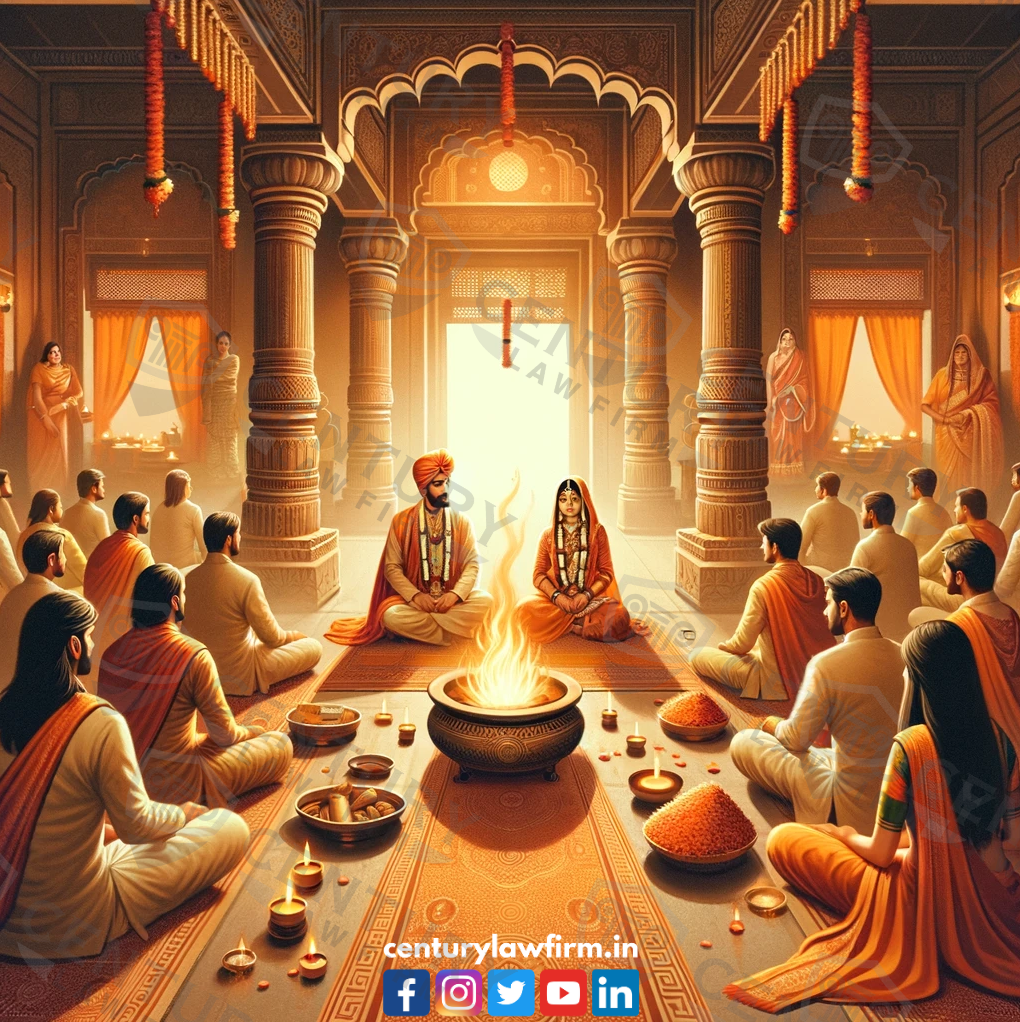
The certificate an Arya Samaj mandir gives is not a government registration. In Sejal Gandhi (30 September 2026), the Delhi High Court said that a marriage under the Hindu Marriage Act “is valid only where it is solemnised between two Hindus in accordance with the essential rites and ceremonies prescribed by Hindu law”, and that the Arya Samaj certificate before it “alone cannot be regarded as conclusive either of the applicability of the HMA to the Parties or of the solemnisation of a valid Hindu marriage thereunder”, as it neither recorded the parties’ religion nor established the conversion of the husband, a foreign national. Couples married in an Arya Samaj mandir should therefore register the marriage with the Revenue Department.
Dowry is prohibited in every form of marriage, not only in Arya Samaj marriages: giving, taking or abetting dowry is punishable with imprisonment of not less than five years (the court may impose less “for adequate and special reasons to be recorded in the judgment”) and a fine of not less than fifteen thousand rupees or the value of the dowry, whichever is more (Dowry Prohibition Act, 1961, Section 3(1)). See also the firm’s note on Section 4 of the Dowry Prohibition Act.
| Point | Court marriage | Arya Samaj marriage |
|---|---|---|
| Law | Special Marriage Act, 1954 | Hindu Marriage Act, 1955 (with the Arya Marriage Validation Act, 1937) |
| Who | Any two persons, any religion; no conversion (Section 4) | Both Hindu (including Arya Samajists), Buddhist, Jain or Sikh (HMA Section 2) |
| Ceremony | Any form, plus the words in Section 12(2), before the Marriage Officer | Customary rites; with Saptapadi, complete at the seventh step (HMA Section 7) |
| Notice and waiting | Notice and thirty days for objections (Sections 5–7) | No notice period in the HMA |
| Witnesses | Three (Sections 11–13) | Two at registration (Delhi guidelines) |
| Proof | Marriage Officer’s certificate, conclusive evidence (Section 13(2)) | Government registration (HMA Section 8; Delhi guidelines); the mandir’s certificate alone is not conclusive (Delhi High Court, 2026) |
Legal effects of a court marriage
The certificate is “conclusive evidence” that the marriage was solemnized (Section 13(2)), and the Marriage Certificate Book is “admissible as evidence of the statements therein contained” (Section 47(1)). A court marriage can also affect family property: a member of an undivided family who professes the Hindu, Buddhist, Sikh or Jaina religion and marries under the Act is severed from that family (Section 19), and succession to the property of a person married under the Act, and of the children, follows the Indian Succession Act, 1925 (Section 21). Where both parties profess one of those four religions, Sections 19 and 21 do not apply (Section 21A), so rules such as the Hindu Succession Act, 1956 continue to govern them.
Matrimonial relief for such couples comes from the Special Marriage Act itself. The Act names the district court, but in Delhi these cases are heard by the Family Courts, which exercise the district court’s jurisdiction in proceedings “between the parties to a marriage for a decree of nullity of marriage … or restitution of conjugal rights or judicial separation or dissolution of marriage” and for maintenance (Family Courts Act, 1984, Sections 7 and 8). The reliefs are restitution of conjugal rights and judicial separation (Sections 22 and 23), nullity (Sections 24 and 25), divorce (Section 27), divorce by mutual consent (Section 28), and maintenance and alimony for the wife (Sections 36 and 37). No divorce petition can be presented until one year after the certificate was entered, except with the court’s leave for “exceptional hardship” or “exceptional depravity” (Section 29). The firm’s guide to matrimonial cases explains these proceedings.
Void and voidable court marriages, and penalties
A marriage under the Act is void if a condition in Section 4(a) to (d) was not fulfilled, or if the respondent was impotent at the time of the marriage and when the case was filed (Section 24(1)). It is voidable if it was not consummated owing to the respondent’s wilful refusal, if the respondent was pregnant by another person at the time of the marriage, or if consent “was obtained by coercion or fraud, as defined in the Indian Contract Act, 1872” (Section 25); for the last two grounds the case must be filed within a year (of the marriage, or of the coercion ending or the fraud being discovered). Children of a void or voidable marriage are legitimate (Section 26).
A person already married who procures a marriage under the Act, or who after such a marriage marries again during the spouse’s lifetime, commits bigamy, and the second marriage is void (Sections 43 and 44). The Act still refers to the Indian Penal Code; the offence is now in Section 82 BNS (formerly Sections 494 and 495 IPC): up to seven years and fine, or up to ten years and fine where the earlier marriage was concealed. A false statement in a declaration or certificate under the Act is the offence in Section 236 BNS (formerly Section 199 IPC) (Section 45).
Court marriage for foreign nationals and NRIs
Section 4 does not make citizenship a condition, but Section 5 requires one party to have resided in the Marriage Officer’s district for thirty days before the notice. For registration, the Revenue Department’s guidelines require one party to be a citizen of India, but its guidelines dated 18 August 2023 on its website say “This condition not applicable, when the both parties are foreign nationals” and ask two foreign nationals for proof of current residence in Delhi, a valid visa on the date of registration and an affidavit attested by their embassy or by an Executive Magistrate (see FAQ 4; video appearance is covered in FAQ 15). In Sejal Gandhi (2026) the Delhi High Court held that an OCI card “does not confer Indian citizenship” and that the thirty-day residence requirement for registering a marriage under Chapter III (Section 15(f)) “cannot be relaxed merely because it causes inconvenience.”
Court marriage and marriage registration work at Century Law Firm
Century Law Firm, at Tis Hazari Courts, Delhi, advises couples on court marriage under the Special Marriage Act and on the registration of marriages in Delhi, including the documents and affidavits, the notice and the appearance before the Marriage Officer, and objections and appeals to the district court. Its other areas of work are listed on the firm’s practice areas page.
दिल्ली में कोर्ट मैरिज कैसे करें और कहाँ होती है – हिंदी में (Court Marriage in Delhi – Summary in Hindi)
आम बोलचाल में जिसे “कोर्ट मैरिज” कहा जाता है, वह कानून में विशेष विवाह अधिनियम, 1954 (Special Marriage Act, 1954) के तहत विवाह अधिकारी (Marriage Officer) के सामने होने वाला विवाह है। अधिनियम में “कोर्ट मैरिज” शब्द कहीं नहीं है और यह विवाह अदालत में नहीं होता। दिल्ली सरकार के राजस्व विभाग के अनुसार SDM, ADM और डिप्टी कमिश्नर विवाह अधिकारी के रूप में अधिकृत हैं। इसलिए दिल्ली में कोर्ट मैरिज आम तौर पर उस SDM के कार्यालय में होती है, जिसके क्षेत्र में पति या पत्नी में से कोई एक रहता है। आवेदन दिल्ली सरकार के ई-डिस्ट्रिक्ट पोर्टल (edistrict.delhigovt.nic.in) से किया जा सकता है, जहाँ राजस्व विभाग की सेवाओं में “Solemnization of Marriage” और “Registration of Marriage” दी गई हैं।
कौन कोर्ट मैरिज कर सकता है: धारा 4 के अनुसार कोई भी दो व्यक्ति, चाहे उनका धर्म या जाति कुछ भी हो, विवाह कर सकते हैं, यदि विवाह के समय किसी का जीवित पति या पत्नी न हो, दोनों वैध सहमति देने में सक्षम हों, पुरुष ने 21 वर्ष और महिला ने 18 वर्ष की आयु पूरी कर ली हो, और दोनों प्रथम अनुसूची में दिए गए निकट संबंधों (प्रतिषिद्ध नातेदारी) में न हों। धर्म बदलने की ज़रूरत नहीं है और अधिनियम माता-पिता की सहमति की शर्त नहीं रखता। इनमें से कोई शर्त पूरी न हो तो विवाह शून्य होता है (धारा 24)।
दिल्ली में कोर्ट मैरिज कैसे करें – चरण दर चरण: (1) दोनों पक्ष द्वितीय अनुसूची के प्रारूप में विवाह की लिखित सूचना उस ज़िले के विवाह अधिकारी को देते हैं, जहाँ उनमें से कम से कम एक व्यक्ति सूचना से ठीक पहले कम से कम 30 दिन से रह रहा हो (धारा 5)। (2) विवाह अधिकारी सूचना को विवाह-सूचना पुस्तक में दर्ज करता है और अपने कार्यालय में प्रमुख स्थान पर लगाता है; यदि कोई पक्ष स्थायी रूप से दूसरे ज़िले में रहता है तो सूचना वहाँ के विवाह अधिकारी को भी भेजी जाती है (धारा 6)। (3) प्रकाशन से 30 दिन के भीतर कोई भी व्यक्ति आपत्ति कर सकता है, लेकिन केवल इस आधार पर कि धारा 4 की कोई शर्त पूरी नहीं होती (धारा 7)। आपत्ति पर विवाह अधिकारी 30 दिन के भीतर निर्णय करता है और इनकार होने पर 30 दिन के भीतर ज़िला न्यायालय में अपील हो सकती है (धारा 8)। (4) 30 दिन बाद दोनों पक्ष और तीन गवाह विवाह अधिकारी के सामने घोषणा पर हस्ताक्षर करते हैं (धारा 11), और प्रत्येक पक्ष दूसरे से किसी भी समझ में आने वाली भाषा में कहता है कि वह उसे अपनी विधिपूर्ण पत्नी या पति के रूप में स्वीकार करता या करती है (धारा 12)। (5) विवाह अधिकारी विवाह प्रमाणपत्र पुस्तक में प्रमाणपत्र दर्ज करता है, जिस पर दोनों पक्ष और तीनों गवाह हस्ताक्षर करते हैं; यह विवाह का निश्चायक साक्ष्य है (धारा 13)। सूचना की तारीख से तीन कैलेंडर महीनों में विवाह न हो तो सूचना व्यपगत हो जाती है और नई सूचना देनी पड़ती है (धारा 14)।
क्या एक ही दिन में कोर्ट मैरिज हो सकती है? नहीं। धारा 7(2) के अनुसार विवाह सूचना के प्रकाशन से 30 दिन बीतने के बाद ही हो सकता है, और जो विवाह अधिकारी जानबूझकर 30 दिन के भीतर विवाह कराता है, उसे एक वर्ष तक के साधारण कारावास या पाँच सौ रुपये तक के जुर्माने या दोनों की सज़ा हो सकती है (धारा 46)। राजस्व विभाग के अनुसार ऐसे विवाह में सामान्यतः 60 दिन के भीतर जवाब मिल जाता है।
ज़रूरी दस्तावेज़ और फीस: राजस्व विभाग के पेज के अनुसार दोनों के हस्ताक्षर वाला आवेदन और फीस की रसीद, दोनों की जन्मतिथि का प्रमाण, किसी एक पक्ष के 30 दिन से अधिक दिल्ली में रहने का प्रमाण, जन्मतिथि, वैवाहिक स्थिति और प्रतिषिद्ध नातेदारी न होने के बारे में अलग-अलग शपथपत्र, राजपत्रित अधिकारी से सत्यापित दो-दो फोटो, और तलाक की डिक्री या पूर्व पति/पत्नी का मृत्यु प्रमाणपत्र (यदि लागू हो)। 20 दिसंबर 2016 को संशोधित दिल्ली विशेष विवाह नियम, 1956 (नियम 11) के अनुसार विवाह की सूचना के लिए 100 रुपये, विवाह संपन्न कराने या पंजीकरण के लिए 500 रुपये और प्रविष्टि की प्रमाणित प्रति के लिए 100 रुपये शुल्क है। कुछ बिना तारीख वाले सरकारी पेजों पर अब भी पुरानी, कम राशि लिखी है; आवेदन करते समय ई-डिस्ट्रिक्ट पर फीस की पुष्टि करें।
कोर्ट मैरिज और पंजीकरण में अंतर: जिनका विवाह पहले ही हिंदू रीति से, आर्य समाज मंदिर में, गुरुद्वारे में या किसी अन्य धार्मिक रीति से हो चुका है, उन्हें कोर्ट मैरिज नहीं, बल्कि पंजीकरण की ज़रूरत है। राजस्व विभाग के दिशानिर्देशों के अनुसार दिल्ली में हुए विवाह का दिल्ली (विवाह का अनिवार्य पंजीकरण) आदेश, 2014 के तहत पंजीकरण अंतिम रस्म के दिन को छोड़कर 60 दिन के भीतर कराना होता है और देर होने पर जुर्माना लगता है; दिशानिर्देशों में इस आदेश के लिए दी गई शर्तों में धर्म की कोई शर्त नहीं है। हिंदू विवाह अधिनियम की धारा 8(5) के अनुसार पंजीकरण न होने से हिंदू विवाह की वैधता पर असर नहीं पड़ता, लेकिन पंजीकरण विवाह का महत्वपूर्ण प्रमाण है। आर्य समाज विवाह हिंदू विवाह अधिनियम के तहत हिंदू विवाह है, और दिल्ली हाई कोर्ट ने 30 सितंबर 2026 को कहा कि आर्य समाज मंदिर का प्रमाणपत्र अकेले यह निश्चायक रूप से साबित नहीं करता कि विवाह इस अधिनियम के तहत वैध रूप से हुआ है। इसलिए ऐसे विवाह का सरकारी पंजीकरण कराना चाहिए। यह सारांश सेंचुरी लॉ फर्म ने अधिनियमों के अंग्रेज़ी पाठ और दिल्ली सरकार के पेजों के आधार पर तैयार किया है।
Frequently asked questions
The couple give written notice to the Marriage Officer (in Delhi, usually the SDM; the application can be made through e-District) of a district where at least one of them has lived for thirty days (Section 5). The notice is entered in the Marriage Notice Book and affixed in the office (Section 6), and anyone may object within thirty days (Section 7). After that, the couple and three witnesses sign a declaration before the Marriage Officer, each party speaks the words in Section 12(2), and the certificate is entered in the Marriage Certificate Book (Sections 11 to 13).
Apply online through the Delhi Government’s e-District portal or at a Citizen Service Centre; the Revenue Department’s pages also direct applicants to the office of the SDM, the ADM or the Deputy Commissioner. The Revenue Department’s guidelines ask for identity, residence and date-of-birth proofs of both parties, identity and permanent Delhi residence proofs of two witnesses, a divorce decree or death certificate if relevant, an embassy certificate for a foreign party, a priest’s certificate where the marriage was at a religious place, a notarised affidavit on Rs 10 e-stamp paper and a photograph. The couple and witnesses then appear on the appointment date.
An Arya Samaj marriage is a Hindu marriage under the Hindu Marriage Act, 1955, which covers followers of the Arya Samaj (Section 2(1)(a)) and requires both parties to be Hindus in the Act’s sense, which includes Buddhists, Jains and Sikhs. It is solemnized by customary rites (Section 7), with no notice period, and should then be registered. A court marriage is a civil marriage under the Special Marriage Act, 1954, open to any two persons of any religion, with a thirty-day notice period and three witnesses.
Yes. Section 4 allows “a marriage between any two persons”, but Section 5 requires one of them to have lived in the Marriage Officer’s district for thirty days before the notice. For registration, Delhi’s Revenue Department asks a foreign party for an embassy certificate of present marital status and nationality. Its guidelines dated 18 August 2023 on its website (following an order of 30 May 2023, as the Delhi High Court recorded in Sejal Gandhi, 2026) let two foreign nationals register under the Act, with proof of current residence in Delhi, a valid visa on the date of registration and an affidavit attested by their embassy or an Executive Magistrate.
Thirty days. Under Section 7(1), anyone may object before thirty days pass from the date the notice is published in the Marriage Officer’s office, on the ground that the marriage would break a condition in Section 4, such as a living spouse, under-age party or prohibited relationship. Under Section 7(2) the marriage may be solemnized only after the thirty days. The period lets anyone who knows of a legal bar raise it before the marriage takes place.
Yes. Under Section 5, at least one party must have resided in the Marriage Officer’s district for “not less than thirty days immediately preceding the date on which such notice is given”; if a party permanently resides in another district, the notice is also sent there (Section 6(3)). The Revenue Department asks for proof that one party has stayed in Delhi for more than thirty days. To register an existing marriage under Section 15, both must have resided in the district for thirty days.
The Revenue Department says a response should normally come within 15 days for registration under the Hindu Marriage Act and within 60 days under the Special Marriage Act; for Hindu Marriage Act registration, a day is fixed after the documents are verified and “The Certificate is issued on the same day”. Its “Registration Of Marriage” page says the certificate “is issued within 14 days”, and the e-District services list shows a “Prescribed Timeline” of 21 for registration and 60 for solemnization of marriage. A court marriage cannot be completed until thirty days after the notice is published (Section 7(2)).
Yes. The Special Marriage Act does not forbid a religious or social ceremony, and Section 12(2) even allows the marriage to be solemnized “in any form which the parties may choose to adopt”, provided each party says the words in Section 12(2) before the Marriage Officer and three witnesses. Legally, a court marriage is proved by the certificate in the Marriage Certificate Book (Section 13(2)), and an Arya Samaj marriage is complete when the rites under Section 7 of the Hindu Marriage Act are performed; a later ceremony does not change that.
Proof. A Special Marriage Act certificate is “conclusive evidence” that the marriage was solemnized (Section 13(2)), and the Hindu Marriage Register is admissible as evidence (Hindu Marriage Act, Section 8(4)). In Seema v. Ashwani Kumar (2006) the Supreme Court said registration “has a great evidentiary value in the matters of custody of children, right of children born from the wedlock” and the age of the parties, though it is not by itself proof that a marriage is valid.
Not for a court marriage. Section 7(2) allows solemnization only after thirty days from publication of the notice, the Act has no power to waive that period, and a Marriage Officer who knowingly solemnizes a marriage within thirty days is punishable under Section 46. Complete documents avoid delay.
An objection counts only if it says the marriage would break a condition in Section 4. The Marriage Officer records it (Section 7(3)), inquires with a civil court’s powers (Section 9(1)) and must decide within thirty days (Section 8(1)). If it is rejected or withdrawn, the marriage goes ahead, and an objector acting unreasonably and in bad faith can be made to pay the couple up to Rs 1,000 (Section 9(2)). If the officer refuses, either party may appeal to the district court within thirty days (Section 8(2)).
Not under the law as it stands. In Supriyo v. Union of India (17 October 2023), a five-judge bench of the Supreme Court rejected the challenge to the Special Marriage Act. The Chief Justice held that the Court “cannot either strike down the constitutional validity of SMA or read words into the SMA” and that it “lies within the domain of Parliament and the state legislatures to enact laws”; another opinion held that reading the Act in a gender-neutral manner “so as to enable same-sex marriage, is unsustainable”.
Yes, three. The couple and three witnesses sign the declaration before the Marriage Officer (Section 11), the words are spoken in the witnesses’ presence (Section 12(2)), and they sign the certificate (Section 13(1)). Registration under Section 15 also needs three witnesses (Section 16). For registration under the Hindu Marriage Act or the Delhi 2014 Order, the Revenue Department’s guidelines require two witnesses with proof of identity and permanent residence in Delhi (its FAQ page, for Hindu Marriage Act registration, mentions “a Gazetted Officer who attended their marriage” instead). The Act sets no age or gender for witnesses.
Partly. “Registration of Marriage” and “Solemnization of Marriage” are listed as Revenue Department services on the e-District portal, and the Revenue Department’s guidelines say that online applicants upload their documents “in e-District application software”, upload scanned affidavits and send the originals to the SDM. The couple and witnesses must still appear in person at the registrar’s office on the appointment date, and some documents may be checked at the counter.
For solemnization, the Act requires the declaration to be signed “in the presence of the Marriage Officer” (Section 11) and the words to be spoken “in the presence of the Marriage Officer and the three witnesses” (Section 12(2)); no official Delhi order allowing solemnization by video was found. For registration, the Delhi guidelines require the parties to be present in person, but the Delhi High Court has allowed video appearance in individual cases. In Sarabjeet Singh Narula v. Government of NCT of Delhi (13 March 2026), the Delhi High Court, following Reena Chadha (2021), let a couple apply through counsel or a power of attorney holder, with documents notarised in the country where they were residing, and appear by video conferencing for registration under the 2014 Order, with two witnesses appearing in person before the SDM and filing affidavits identifying them. In Sejal Gandhi (2026) it allowed video conferencing “to the extent permissible under the applicable law and procedure”.
No. “Court marriage” is the everyday name for a marriage solemnized under the Special Marriage Act, 1954; the Act never uses the phrase. The marriage takes place before a Marriage Officer appointed under Section 3, not a judge; in Delhi the Revenue Department has authorised SDMs, ADMs and Deputy Commissioners as Marriage Officers. According to its Statement of Objects and Reasons, the Act offers “a special form of marriage” to any person “irrespective of the faith which either party to the marriage may profess”.
In the office of the Marriage Officer, usually the Sub-Divisional Magistrate (SDM) of the Delhi Government’s Revenue Department, not in a court. The Revenue Department directs couples to the SDM “in whose jurisdiction any of the husband or wife resides”, and the notice must go to the Marriage Officer of a district where one party has lived for thirty days (Section 5). The marriage may be solemnized at that office or at another place within a reasonable distance, on prescribed conditions and additional fees (Section 12(1)).
उस ज़िले के विवाह अधिकारी (SDM) को विवाह की लिखित सूचना दें (आवेदन ई-डिस्ट्रिक्ट पोर्टल से भी किया जा सकता है), जहाँ आप दोनों में से कम से कम एक व्यक्ति 30 दिन से रह रहा हो (धारा 5)। सूचना कार्यालय में प्रकाशित होगी और 30 दिन तक कोई भी धारा 4 के आधार पर आपत्ति कर सकता है (धारा 7)। 30 दिन बाद और सूचना से तीन महीने के भीतर, तीन गवाहों के साथ विवाह अधिकारी के सामने घोषणा पर हस्ताक्षर करें और विवाह संपन्न करें; प्रमाणपत्र विवाह प्रमाणपत्र पुस्तक में दर्ज होगा (धारा 11 से 14)।
Under rule 11 of the Delhi Special Marriage Rules, 1956, as amended by the Delhi Special Marriage Registration (Amendment) Rules, 2016 (20 December 2016), the notice of intended marriage costs Rs 100, solemnizing or registering the marriage Rs 500 and a certified copy Rs 100 per entry. Registering a Hindu marriage, or a marriage under the Delhi (Compulsory Registration of Marriage) Order, 2014, also costs Rs 500. Additional fees may apply if the marriage is solemnized away from the office (Section 12(1)). Some undated Delhi Government pages still show older, lower figures; confirm the fee on e-District when applying.
No. Under Section 7(2) a marriage can be solemnized only after thirty days from the date the notice is published, and under Section 46 a Marriage Officer who knowingly and wilfully solemnizes a marriage within those thirty days can be punished with simple imprisonment of up to one year, a fine of up to Rs 500, or both. What the Revenue Department describes as done “on the same day” is the issue of the certificate when registering a Hindu marriage already performed, on the day fixed after verification.
According to the Revenue Department: the application form signed by both, the fee receipt, proof of date of birth of both, proof that one party has stayed in Delhi for more than thirty days, separate affidavits on date of birth, marital status and the absence of a prohibited relationship, two photographs of each attested by a Gazetted Officer, and a divorce decree or the former spouse’s death certificate where relevant. Three witnesses attend the solemnization (Sections 11 to 13); the Revenue Department advises submitting their names at least one day in advance.
Under Section 4(c) of the Special Marriage Act, “the male has completed the age of twenty-one years and the female the age of eighteen years” at the time of the marriage, and a marriage in breach of this is void (Section 24(1)). To register under Section 15 a marriage celebrated in another form, both must have completed twenty-one years (Section 15(d)). The Hindu Marriage Act sets the same 21 and 18 (Section 5(iii)).
Section 3 lets the State Government appoint Marriage Officers by notification, and for a Union territory “State Government” means its administrator (Section 2(g)). The Delhi Government’s Revenue Department states that “SDMs/ADMs/Deputy Commissioners have been authorised as Marriage Officers” for marriages under the Act. In practice, couples deal with the SDM of the area where one of them lives.
Yes. Section 4 allows “a marriage between any two persons” who meet its conditions, none of which concerns religion, so neither party needs to convert. Where a Hindu, Buddhist, Sikh or Jain marries a person of another religion under the Act, the marriage severs him or her from an undivided family (Section 19) and succession follows the Indian Succession Act, 1925 (Section 21); these rules do not apply if both are Hindu, Buddhist, Sikh or Jain (Section 21A).
No. The conditions in Section 4 are about the couple: no living spouse, capacity to consent, age (21 for the man, 18 for the woman) and prohibited relationships. Parental consent is not among them. Anyone, including a parent, may object within thirty days of the notice, but only on the ground that a Section 4 condition is not met (Section 7(1)), and the Marriage Officer must decide within thirty days (Section 8(1)).
For a marriage solemnized in Delhi with one party an Indian citizen, the Revenue Department’s guidelines say that registration under the Delhi (Compulsory Registration of Marriage) Order, 2014, which has no religion condition in those guidelines, “shall be done within a period of 60 days, excluding the day on which final ceremony of marriage is solemnized”, and that a penalty “shall be imposed” if it is not done in time. Registration is still not what makes a marriage valid: Section 8(5) of the Hindu Marriage Act says failure to register does not affect a Hindu marriage’s validity, and in Seema v. Ashwani Kumar (2006) the Supreme Court said registration is not by itself proof of a valid marriage.
Not on its own. In Sejal Gandhi v. Government of NCT of Delhi (30 September 2026), the Delhi High Court held that the Arya Samaj certificate before it “alone cannot be regarded as conclusive either of the applicability of the HMA to the Parties or of the solemnisation of a valid Hindu marriage thereunder”. Couples married in an Arya Samaj mandir should register the marriage with the Revenue Department, which asks for a conversion certificate where a party was not a Hindu, Buddhist, Jain or Sikh.
The notice lapses. Under Section 14, if the marriage is not solemnized within three calendar months from the date the notice was given (or within three months of the district court’s decision where there was an appeal), the notice and all proceedings on it “shall be deemed to have lapsed”, and no Marriage Officer can solemnize the marriage until a new notice is given, with a fresh thirty-day period.
Yes, if they have no spouse living at the time of the marriage (Section 4(a)). The notice and declaration record whether a party is unmarried, widowed or divorced, and the Revenue Department asks for the divorce decree or the former spouse’s death certificate. A person still married who procures a marriage under the Act commits bigamy, now in Section 82 BNS (formerly Sections 494 and 495 IPC), and that marriage is void (Section 43).
Conclusion
A court marriage in Delhi is a civil marriage under the Special Marriage Act, 1954, solemnized before a revenue officer acting as Marriage Officer, usually the SDM, and open to any two persons who meet Section 4, whatever their religion. Its steps are fixed by the Act: notice in a district where one party has lived for thirty days, publication, thirty days for objections, and then, within three months of the notice, a declaration and solemnization before three witnesses and a certificate in the Marriage Certificate Book. There is no same-day route. Couples already married by religious rites, including in an Arya Samaj mandir, need registration instead; for a marriage solemnized in Delhi, the Revenue Department’s guidelines say registration under the Delhi (Compulsory Registration of Marriage) Order, 2014 “shall be done within a period of 60 days” of the final ceremony. Matrimonial cases between couples married under the Act are heard in Delhi by the Family Courts. Because the Delhi pages differ on fees and are partly undated, check the documents, fee and appointment shown on e-District when applying; the law itself does not change with the portal.
Sources used for this post: the Special Marriage Act, 1954, Sections 1 to 9, 11 to 29, 36, 37, 42 to 50, the First to Fifth Schedules and the Statement of Objects and Reasons (India Code, as on 15 April 2026); the Hindu Marriage Act, 1955, Sections 2, 5, 7 and 8 (India Code, as on 15 April 2026); the Arya Marriage Validation Act, 1937, Sections 1 and 2 (India Code); the Dowry Prohibition Act, 1961, Section 3 (India Code, as on 30 July 2026); the Family Courts Act, 1984, Sections 7 and 8 (India Code); the Bharatiya Nyaya Sanhita, 2023, Sections 82 and 236 (India Code, as on 6 October 2025, with the firm’s section-by-section data checked against the Gazette text); the Revenue Department, Government of NCT of Delhi: “Marriage Registration” page (revenue.delhi.gov.in/hi/node/7684), “Registration Of Marriage” page (revenue.delhi.gov.in/revenue/registration-marriage), “Guidelines for Issuance of Marriage Registration Certificate” dated 18 August 2023 on its “What’s New” page (revenue.delhi.gov.in/sites/default/files/revenue/important-news/guidelines_marriageregistration.pdf) and the undated copy published on the District New Delhi website, the notice and application forms, and the Act Wise Marriage Registration Report for May 2024; the Delhi Gazette (Extraordinary, Part IV) notification of the Revenue Department No. F.223/SDM-II(HQ)/Land/2025/285 dated 25 December 2025 creating thirty-nine sub-divisions; the Delhi Special Marriage Registration (Amendment) Rules, 2016 (No. F.1(12)/DC/MC/2014/491-571) and the Delhi Hindu Marriage Registration (Amendment) Rules, 2016 (No. F.1(12)/DC/MC/2014/410-490), both dated 20 December 2016, and the Delhi (Compulsory Registration of Marriage) Amendment Order, 2016 (No. F.1(12)/DC/MC/2014/572-652, 20 December 2016), in the Revenue Department’s copies (revenue.delhi.gov.in, read on 23 October 2026); District New Delhi, “Marriage Registration Certificate” service page; District Magistrate (Central), “Marriage Certificates” page (dccentral.delhi.gov.in); e-District Delhi, “Services Available At e-District Delhi” (edistrict.delhigovt.nic.in), all read on 22 October 2026; the Supreme Court’s own copies of Seema v. Ashwani Kumar, Transfer Petition (Civil) 291 of 2005 (14 February 2006, https://api.sci.gov.in/jonew/judis/27482.pdf) and Supriyo @ Supriya Chakraborty v. Union of India, W.P.(C) 1011 of 2022 (17 October 2023, https://main.sci.gov.in/supremecourt/2022/36593/36593_2022_1_1501_47792_Order_17-Oct-2023.pdf); and the Delhi High Court’s own copies of Sejal Gandhi v. Government of NCT of Delhi, W.P.(C) 10993/2026 (30 September 2026, https://delhihighcourt.nic.in/app/showFileJudgment/68730092026CW109932026_143307.txt) and Sarabjeet Singh Narula v. Government of NCT of Delhi, W.P.(C) 3257/2026 (13 March 2026, https://delhihighcourt.nic.in/app/showFileJudgment/59613032026CW32572026_140514.pdf), the latter quoting Reena Chadha v. Government of NCT of Delhi, W.P.(C) 6653/2021.
