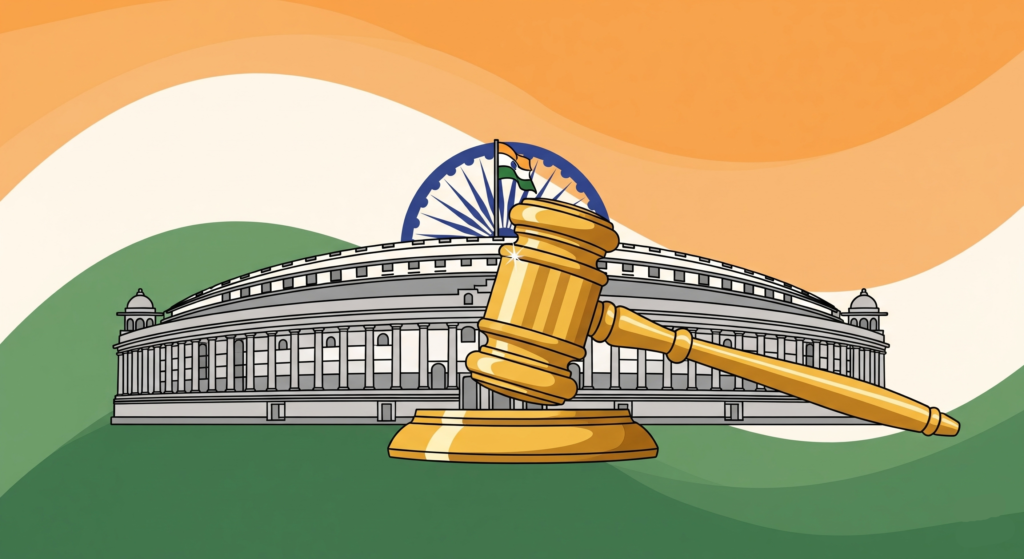
Indian Constitution (1950)

Dive deep into the Indian Constitution enacted in 1950. Understand the fundamental rights, preamble, and legislative structure. Stay updated with the latest amendments and interpretations since its inception. As the bedrock of the world’s largest democracy, the Indian Constitution, instituted in 1950, stands not merely as a written code but as a living testament to India’s socio-political ethos. This monumental document encapsulates the dreams and aspirations of a nation that had just unshackled itself from colonial rule. It uniquely intertwines the principles of justice, liberty, equality, and fraternity in its preamble, setting the tone for the vast landscape of rights, duties, and provisions it delineates. Fundamental Rights ensure the citizenry’s basic human rights, while the Directive Principles lay out the nation’s socio-economic goals. Over the years, the Constitution has witnessed amendments, reflecting the changing needs of a dynamic society. It’s also shaped by notable Constitution Bench Judgments that address complex legal quandaries. This category seeks to unravel the intricacies of this grand document, offering readers insights into its various articles, the historical contexts, landmark amendments, and evolving interpretations. It serves as a comprehensive repository for scholars, legal practitioners, students, and anyone keen on understanding the foundational principles that guide India’s republic.

Uniform Civil Code (UCC) in India A Comprehensive Legal Analysis

Uniform Civil Code (UCC) in India: A Comprehensive Legal Analysis

By: Falak Imam What is the Uniform Civil Code? A Uniform Civil Code (UCC) refers to a single law applicable to all citizens of a country in personal matters such as marriage, divorce, custody, adoption, inheritance, and succession. In India, the purpose of a uniform civil code is to replace personal laws based on religions […]

Uniform Civil Code (UCC) in India: A Comprehensive Legal Analysis Read More »

The Unbalanced Alliance of IP Laws and Free Speech Finding the Balance Between Protection and Expression

The Unbalanced Alliance of IP Laws and Free Speech: Finding the Balance Between Protection and Expression

By: Aastha Arora Introduction What liberty means to people is freedom of free speech and expression with a glimpse of freedom to criticize, balancing that all with the right to publicity. In this hyperactive, dynamic, and creative world, every third person wants to be an influencer who wants to gain attention through memes and viral

The Unbalanced Alliance of IP Laws and Free Speech: Finding the Balance Between Protection and Expression Read More »

JUSTICE BEYOND BOUNDARIES: EVOLUTION OF JUDICISL ACTIVISM IN INDIA

JUSTICE BEYOND BOUNDARIES: EVOLUTION OF JUDICIAL ACTIVISM IN INDIA

By: Anchal Agrawal Introduction In a democracy governed by the rule of law, the judiciary plays a pivotal role in interpreting and upholding the Constitution. Over the years, Indian courts have gone beyond traditional boundaries to address gaps left by the legislature and executive—a phenomenon widely known as judicial activism. This proactive approach, especially in

JUSTICE BEYOND BOUNDARIES: EVOLUTION OF JUDICIAL ACTIVISM IN INDIA Read More »

Double Jeopardy in India Constitutional Safeguards and Contemporary Challenges

Double Jeopardy in India: Constitutional Safeguards and Contemporary Challenges

By: Harshpreet Kaur Introduction Double jeopardy, the principle that prohibits an individual from being prosecuted or punished multiple times for the same offense, is a cornerstone of criminal justice systems worldwide. In India, this principle is enshrined in the Constitution and reinforced through judicial interpretations, reflecting the country’s commitment to fairness and protection against state

Double Jeopardy in India: Constitutional Safeguards and Contemporary Challenges Read More »

Special Leave Petition: Meaning, Features, Process and Who can file it ?

By: Chetna Singhal Introduction: The Indian judicial system, known for its complexity and layered structure, offers various legal remedies to ensure justice is served. Among these remedies, the Special Leave Petition (SLP) stands out as a powerful tool that allows individuals to seek the Supreme Court’s intervention in cases where they believe justice has not

Special Leave Petition: Meaning, Features, Process and Who can file it ? Read More »

Right to Privacy in India Exploring Article 21 and the Landmark Puttaswamy Judgment

Right to Privacy in India: Exploring Article 21 and the Landmark Puttaswamy Judgment

By: Rakshita Raj Protecting individual’s right: The legal implications of Puttaswamy Judgment. The privacy is a word often used in the growing India. Is this privacy so important in anyone’s life that it can infringe the rights of others. The Biometrics identification is one of the most private pillar of every citizen in India.  Right

Right to Privacy in India: Exploring Article 21 and the Landmark Puttaswamy Judgment Read More »

Freedom of Trade, Commerce and Intercourse under the Indian Constitution, 1950

Freedom of Trade, Commerce and Intercourse under the Indian Constitution, 1950

Author: Anshita Jain, 3rd Semester, BBA LLB, Maharaja Agrasen Institute of Management Studies Introduction India, with its rich history of trade and commerce, has always been a hub for merchants and traders. The Indian Constitution, recognizing the importance of trade, has dedicated an entire part to ensure its free flow. Drawing inspiration from the Australian

Freedom of Trade, Commerce and Intercourse under the Indian Constitution, 1950 Read More »

Article 19 of the Indian Constitution: A Comprehensive Analysis

Article 19 of the Indian Constitution: A Comprehensive Analysis

Introduction: The Indian Constitution, the world’s lengthiest written constitution, is a testament to the country’s diverse culture and rich heritage. Among its many provisions, Article 19 stands out as a beacon of freedom, embodying the democratic ethos of the nation. This blog post aims to provide a comprehensive analysis of Article 19, its legal provisions,

Article 19 of the Indian Constitution: A Comprehensive Analysis Read More »