Most Used Legal Maxims, Translation and Meanings

Most Used Legal Maxims, Translation and Meanings with easy explanation that everyone needs to know. Legal Maxim of the Day. These legal maxims are useful for lawyers, business owners, and more.

The law is often described as “a body of rules.” But in reality, the law is much broader than that. It includes principles, precedents, and maxims. Maxims are concise statements of general principles that apply to many situations. They’re also called “legal maxims” because they’re used by judges and lawyers to explain how the law works.

They will help you avoid common mistakes and pitfalls when dealing with contracts, negotiations, and other legal matters.

Here’s an example of a legal maxim: “The law favours the vigilant and not those who sleep upon their rights.” This means that people should take care to protect themselves against potential risks. If you do nothing, you might lose your right to sue someone else for damages.

Actori incumbit probatio

Actori Incumbit Probatio: Meaning, Examples and the Burden of Proof in Indian Law (Sections 104–120 BSA, formerly Sections 101–114A of the Evidence Act)

Actori incumbit probatio is a Latin legal maxim meaning “the burden of proof lies on the plaintiff”: the person who asks a court for a judgment must prove the facts on which the claim rests. In India the maxim is written into Section 104 of the Bharatiya Sakshya Adhiniyam, 2023 (BSA), formerly Section 101 of

Actori Incumbit Probatio: Meaning, Examples and the Burden of Proof in Indian Law (Sections 104–120 BSA, formerly Sections 101–114A of the Evidence Act) Read More »

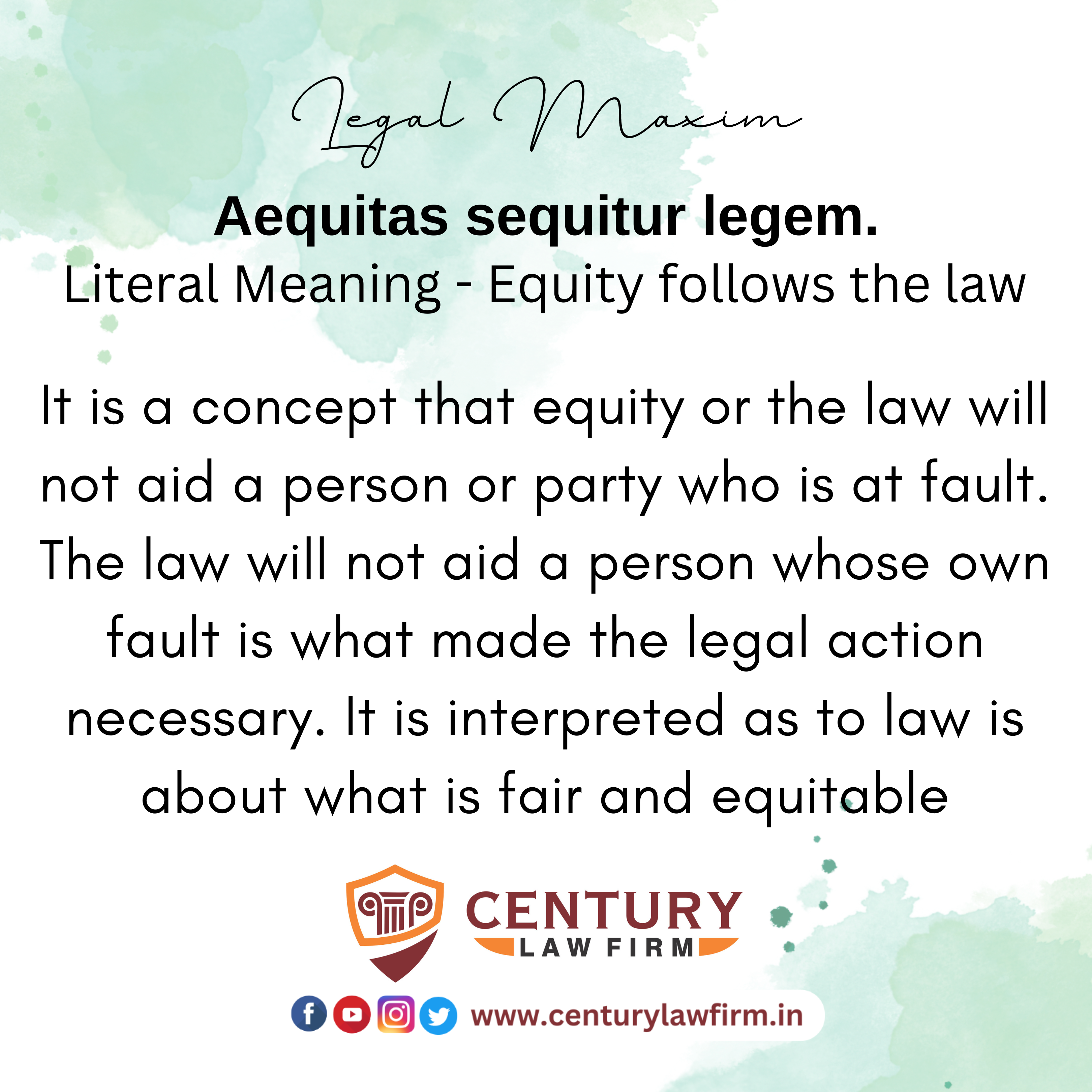
Aequitas sequitur legem - Legal Maxim

Aequitas Sequitur Legem (Equity Follows the Law): Meaning of the Maxim and Its Words, How Indian Courts Apply It, Cases and Summary in Hindi

Aequitas sequitur legem is a Latin legal maxim meaning “equity follows the law”. Fairness (equity) works inside the law, not against it: a court may use equity to fill a gap where no law applies, or to apply a law fairly, but it cannot use equity to set aside a clear statute. The Supreme Court

Aequitas Sequitur Legem (Equity Follows the Law): Meaning of the Maxim and Its Words, How Indian Courts Apply It, Cases and Summary in Hindi Read More »

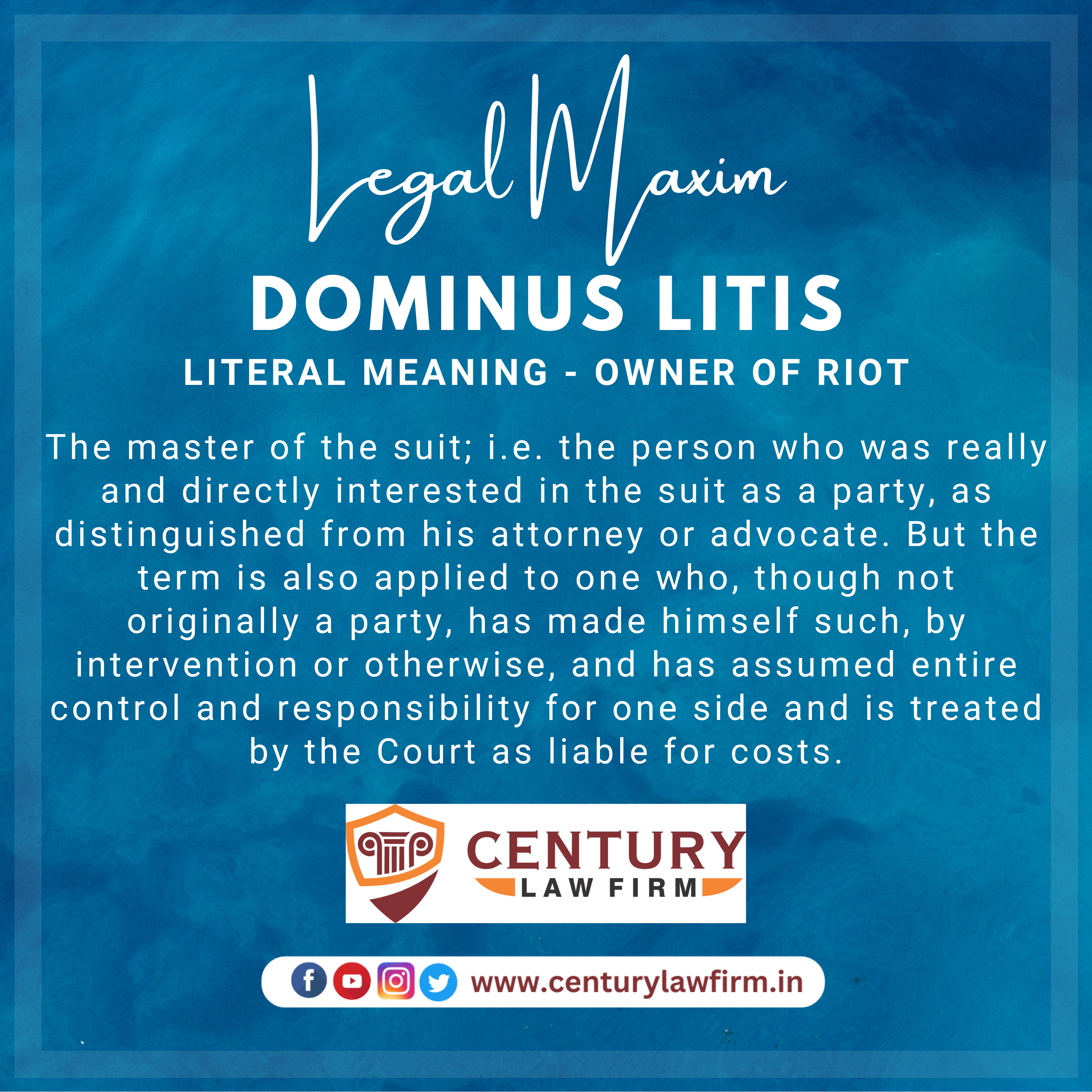
Dominus Litis - Legal Maxim

Dominus Litis Meaning: Why the Plaintiff Is Master of the Suit, and Who Controls a Criminal Case

Dominus litis is a Latin phrase meaning “master of the suit” (dominus = master or owner; litis = of the suit or lawsuit). In Indian courts it is used for the party who controls a case. In a civil suit that party is the plaintiff: he decides whom to sue and what to claim, and,

Dominus Litis Meaning: Why the Plaintiff Is Master of the Suit, and Who Controls a Criminal Case Read More »

Jus ad rem.

Jus Ad Rem: Meaning, Jus Ad Rem vs Jus In Rem and Jus In Re, and Why an Agreement to Sell Is Not Ownership (Section 54, Transfer of Property Act)

Jus ad rem (also spelt ius ad rem) is a Latin legal expression meaning “a right to a thing”: a right to obtain a thing from a particular person, as opposed to a right in the thing itself. The Supreme Court of India used exactly that gloss in 2010, speaking of a person who “has

Jus Ad Rem: Meaning, Jus Ad Rem vs Jus In Rem and Jus In Re, and Why an Agreement to Sell Is Not Ownership (Section 54, Transfer of Property Act) Read More »

century law firm legal maxim volenti non fit injuria

Volenti Non Fit Injuria: Meaning, Essentials, Exceptions, Case Law, BNS Sections 25–30 and Meaning in Hindi

Volenti non fit injuria is a Latin legal maxim that literally means “to a willing person, no injury is done”. In plain words: if you knowingly and freely accept a risk, you cannot later sue the person who exposed you to that risk for the harm it causes. The Delhi High Court has described it

Volenti Non Fit Injuria: Meaning, Essentials, Exceptions, Case Law, BNS Sections 25–30 and Meaning in Hindi Read More »

century law firm legal maxim respondeat superior

Respondeat Superior: Meaning, Vicarious Liability, Case Law, Examples and Meaning in Hindi

Respondeat superior is a Latin maxim, usually rendered in English as “let the master answer” (our rendering). It is the rule of vicarious liability: an employer (the “master”) is liable for a wrong done by an employee (the “servant”) while acting in the course of employment, even though the employer did nothing wrong personally. In

Respondeat Superior: Meaning, Vicarious Liability, Case Law, Examples and Meaning in Hindi Read More »

century law firm legal maxim Audi alteram partem

Audi Alteram Partem: Meaning, Rule of Hearing, Case Law, Exceptions and Meaning in Hindi

Audi alteram partem is a Latin legal maxim meaning “hear the other side”. Those are the Supreme Court’s own words: in Union of India v. Tulsiram Patel (1985) the Constitution Bench described the second rule of natural justice as “audi alteram partem”, that is, “hear the other side”, and in Olga Tellis v. Bombay Municipal

Audi Alteram Partem: Meaning, Rule of Hearing, Case Law, Exceptions and Meaning in Hindi Read More »

Call Now WhatsApp
WhatsApp

Disclaimer

As per The Bar Council of India Rules and The Advocates Act, 1961, an advocate cannot approach his/her client or advertise or promote his profession by way of advertisements or solicitation. Thus, this website has not been created to approach or solicit our client or advertise our firm but to provide some necessary information about our firm and services to our existing clients.

Any user of this website is warned that the contents stated herein are not guaranteed to be accurate, up-to-date or complete. Century Law Firm disclaims all responsibilities and liabilities for interpretation or use of information contained on this website nor does it offer any warranty expressed or implied. The information provided under this website is solely available at your request for informational purposes only, should not be interpreted as soliciting or advisement.

The contents of this website shall not be considered as Legal Advice as the contents thereof is not exhaustive. It is only introductory. In cases where the user has any legal issues, he/she in all cases must seek independent legal advice. We are not liable for any consequence of any action taken by the user relying on material/information provided under this website. The viewer acknowledges that he or she has read and understood the disclaimer as provided hereinabove.