Century Law Firm Logo

Legal Section of the Day

Legal Section of the Day. Here we post one legal section of any Act per day. Check out and Follow us to get your daily dose of legal knowledge

Section 379 of The Code Of Criminal Procedure, 1973 - Appeal against conviction by High Court in certain cases CrPC

Section 379 CrPC (Now Section 420 BNSS): Appeal to the Supreme Court Against Conviction by the High Court, in English and Hindi

Section 379 of the Code of Criminal Procedure, 1973 (CrPC) gives a person a direct appeal to the Supreme Court when the High Court, hearing an appeal, has reversed his acquittal, convicted him and sentenced him to death, to imprisonment for life or to imprisonment for ten years or more. Since 1 July 2024 the

Section 379 CrPC (Now Section 420 BNSS): Appeal to the Supreme Court Against Conviction by the High Court, in English and Hindi Read More »

section 13 of national security act 1980

Section 13 of the National Security Act, 1980 – Maximum Period of Detention

Under Section 13 of the National Security Act, 1980 (NSA), the maximum period for which a person can be held under a detention order that has been confirmed under Section 12 is twelve months from the date of detention. The Government that is responsible for the order (the “appropriate Government”) can revoke or modify it

Section 13 of the National Security Act, 1980 – Maximum Period of Detention Read More »

section 3 of prevention of insults to national honour act 1971

Section 3 of Prevention of Insults to National Honour Act, 1971 – Section of the Day

Section 3 of Prevention of Insults to National Honour Act, 1971 Prevention of singing of Indian National Anthem Whoever intentionally prevents the singing of the Indian National Anthem or causes disturbance to any assembly engaged in such singing shall be punished with imprisonment for a term which may extend to three years, or with fine,

Section 3 of Prevention of Insults to National Honour Act, 1971 – Section of the Day Read More »

section 149 of crpc

Section 149 CrPC (Now Section 168 BNSS): Police Duty to Prevent Cognizable Offences – Preventive Action of the Police, Arrest under Section 151 (Now 170) and धारा 149 in Hindi

Section 149 of the Code of Criminal Procedure, 1973 (CrPC) made it the duty of every police officer to prevent cognizable offences. Since 1 July 2024 the same rule, word for word, is Section 168 of the Bharatiya Nagarik Suraksha Sanhita, 2023 (BNSS): “Every police officer may interpose for the purpose of preventing, and shall,

Section 149 CrPC (Now Section 168 BNSS): Police Duty to Prevent Cognizable Offences – Preventive Action of the Police, Arrest under Section 151 (Now 170) and धारा 149 in Hindi Read More »

Section 22 OF limitation ACT, 1963

Section 22 of the Limitation Act, 1963: Continuing Breach of Contract and Continuing Tort, with the Text in English and Hindi, Section 2(m), Supreme Court Cases and Time Limits

Section 22 of the Limitation Act, 1963 deals with “Continuing breaches and torts”. It says that “In the case of a continuing breach of contract or in the case of a continuing tort, a fresh period of limitation begins to run at every moment of the time during which the breach or the tort, as

Section 22 of the Limitation Act, 1963: Continuing Breach of Contract and Continuing Tort, with the Text in English and Hindi, Section 2(m), Supreme Court Cases and Time Limits Read More »

Section 27 of Arms Act, 1959 - Section of the Day

Section 27 of the Arms Act, 1959: Punishment for Using Arms – 27(1), 27(2), 27(3), Bail, Court and 3/25/27, in English and Hindi

Section 27 of the Arms Act, 1959 punishes the use of arms. Using any arms or ammunition in contravention of Section 5 is punishable with three to seven years’ imprisonment and fine (Section 27(1)); using prohibited arms or prohibited ammunition in contravention of Section 7, with seven years to life imprisonment and fine (Section 27(2));

Section 27 of the Arms Act, 1959: Punishment for Using Arms – 27(1), 27(2), 27(3), Bail, Court and 3/25/27, in English and Hindi Read More »

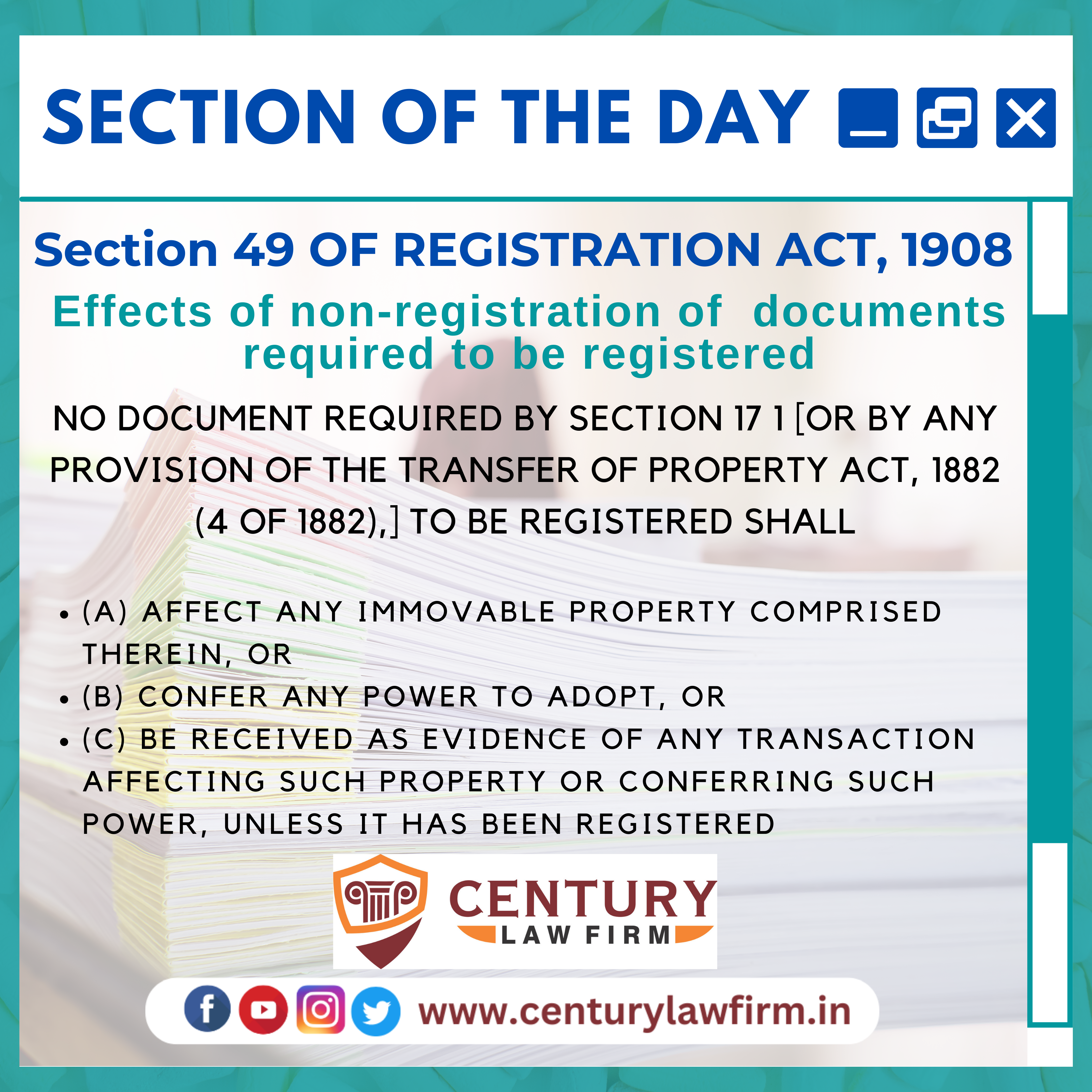
Section 49 OF REGISTRATION ACT, 1908 - Effects of Non-Registration of Documents Required to be Registered

Section 49 of the Registration Act, 1908: Effect of Non-Registration of Documents, the Proviso and Supreme Court Cases

Section 49 of the Registration Act, 1908 is the provision that gives compulsory registration its force. When a document that Section 17 of the Act, or any provision of the Transfer of Property Act, 1882, requires to be registered is left unregistered, Section 49 says that it cannot affect the immovable property it deals with,

Section 49 of the Registration Act, 1908: Effect of Non-Registration of Documents, the Proviso and Supreme Court Cases Read More »

SECTION 304(A) OF IPC

Section 304A IPC (Now Section 106 BNS): Death by Negligence – Meaning, Punishment, Bail, 304 vs 304A, Hit-and-Run and धारा 304A in Hindi

Section 304A of the Indian Penal Code (IPC) punished causing the death of a person by a rash or negligent act that does not amount to culpable homicide, with imprisonment of up to two years, or fine, or both. The IPC was repealed with effect from 1 July 2024, and the same offence is now

Section 304A IPC (Now Section 106 BNS): Death by Negligence – Meaning, Punishment, Bail, 304 vs 304A, Hit-and-Run and धारा 304A in Hindi Read More »

Phone WhatsApp
WhatsApp

Disclaimer

As per The Bar Council of India Rules and The Advocates Act, 1961, an advocate cannot approach his/her client or advertise or promote his profession by way of advertisements or solicitation. Thus, this website has not been created to approach or solicit our client or advertise our firm but to provide some necessary information about our firm and services to our existing clients.

Any user of this website is warned that the contents stated herein are not guaranteed to be accurate, up-to-date or complete. Century Law Firm disclaims all responsibilities and liabilities for interpretation or use of information contained on this website nor does it offer any warranty expressed or implied. The information provided under this website is solely available at your request for informational purposes only, should not be interpreted as soliciting or advisement.

The contents of this website shall not be considered as Legal Advice as the contents thereof is not exhaustive. It is only introductory. In cases where the user has any legal issues, he/she in all cases must seek independent legal advice. We are not liable for any consequence of any action taken by the user relying on material/information provided under this website. The viewer acknowledges that he or she has read and understood the disclaimer as provided hereinabove.